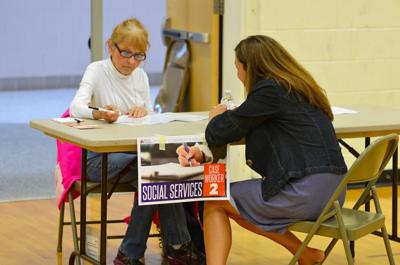



Poverty Simulation participants are exposed to helpful resources that are available to assist individuals who have limited resources.
“Neighbors helping neighbors is more than just a tagline for Crisis Control Ministry,” stated the nonprofit’s executive director, Margaret Elliott. “It is the heart of who we are and how we serve.”
The ministry helps those in crisis with financial assistance to pay for housing, utilities, food and prescription medications. While many are aware that Crisis Control Ministry is the largest nonprofit provider of these emergency services serving Forsyth and Stokes counties, fewer are aware of the ministry’s advocacy role.
“You never completely understand until you walk a mile in someone’s shoes” is a phrase that elucidates three interactive advocacy programs at Crisis Control Ministry. “The first step to helping our neighbors is developing an understanding of their situation,” said director of philanthropy Rev. George Banks, who facilitates the Living on the Edge program. This 90-minute interactive presentation is ideal for small groups. It helps participants realize how life circumstances beyond an individual’s control can dramatically impact their life and create a crisis for the individual.
Crisis Control Ministry’s Poverty Simulation is an immersive role-playing experience where participants are transported from their own daily lives to that of an individual living near the poverty level. A simulation puts participants into situations of a four-week period played out in 15-minute segments.
Volunteers play the roles of social agencies, schools and employers, while participants navigate their way through the obligations of work, parenting, paying bills and buying groceries with limited resources. One volunteer commented: “I found this to be a valuable experience. I work in the service field and I was surprised by the participants’ lack of knowledge about things I thought were common knowledge.”
When people are not faced with limited resources, it’s easy to take things for granted. One participant shared: “It helped me understand the daily stresses of living in poverty. It shows very well how the daily aspects of living can become challenging and pile up on each other when you don’t have enough resources to cover everything you need.”
In addition, Crisis Control Ministry offers a four-hour seminar called Bridges Out of Poverty, based on the book by the same name. It guides participants through the history of poverty and provides tools beyond the core constructs that can bring about change at the individual, institutional, community and policy levels. This program is designed to prepare individuals to join Crisis Control Ministry advocates to identify and champion local, statewide and national initiatives that impact neighbors who are experiencing a crisis.
Neighbors helping neighbors is not about providing a handout. It is about providing a helping hand and joining together to help build a stronger community for all. Founding director Rev. Ron Rice summed it up when he said: “All things become possible in a loving community.”
Crisis Control Ministry’s 50 years of service to the community have proven that to be true.
To learn more, volunteer with the programs or host a program, go to crisiscontrol.org or contact Abbey McCall, director of community and volunteer relations, at 336.770.1621 or at amccall@crisiscontrol.org.