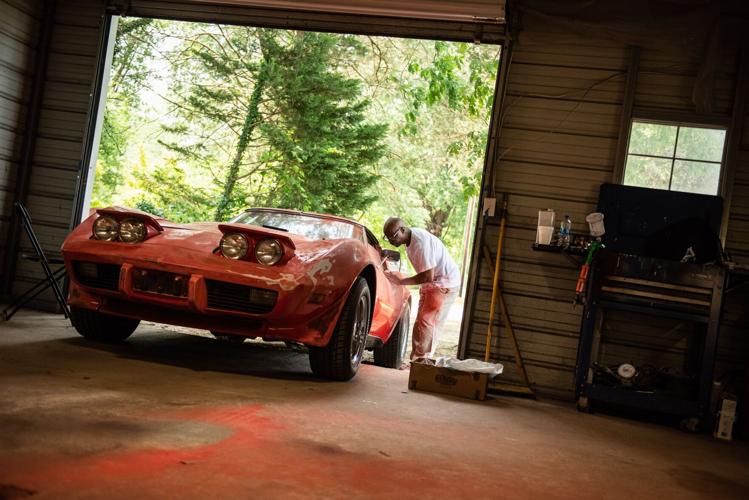


In the backyard of his older brother’s house, Henry Jerome White did what he grew up doing — working on cars.
It had been 26 years since he had been able to do what he loved. For more than a year, he was held in the Forsyth County Jail and then for more than 20 years, White was behind bars in state prison for first-degree murder in the 1996 death of Carl Earl Marshburn. Forsyth County prosecutors alleged that he shot Marshburn, the manager of Earl Scheib Paint and Body Shop in Winston-Salem, twice and then robbed him. White claimed innocence. He was supposed to spend the rest of his life in prison.

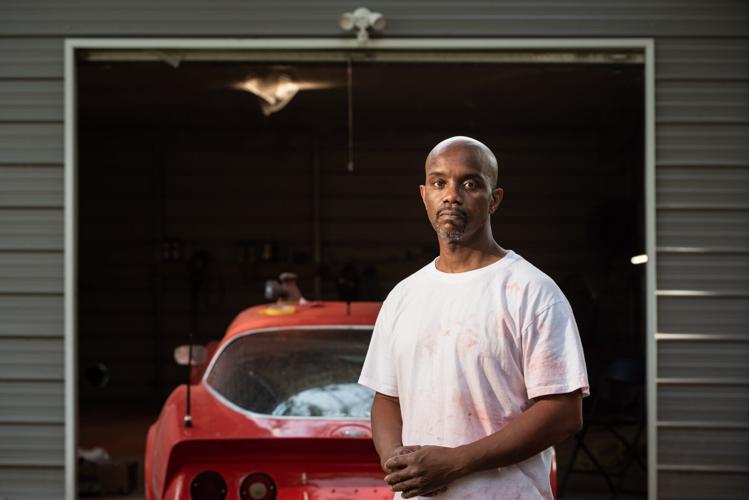
Henry White stands for a portrait in front of a 1977 Corvette he’s repainting.
But on Thursday, May 19, White was outside in the hot sun, his white T-shirt colored with splotches of red paint as he sanded a bright-red 1977 Corvette by an outbuilding on his brother’s property in Kernersville. Small with a muscled frame, White is soft-spoken. His eyes are wide to the world that, until now, he hasn’t seen much of beyond prison walls.
People are also reading…
He is at peace.
A little more than a week before, White was released from prison. In an unusual arrangement, he saw his first-degree murder conviction thrown out in exchange for a plea to second-degree murder. Judge David Hall of Forsyth Superior Court sentenced White to between about 13 years and 16 years in prison. He had already served more than that, and later that day, May 9, he was released from the Forsyth County Jail.

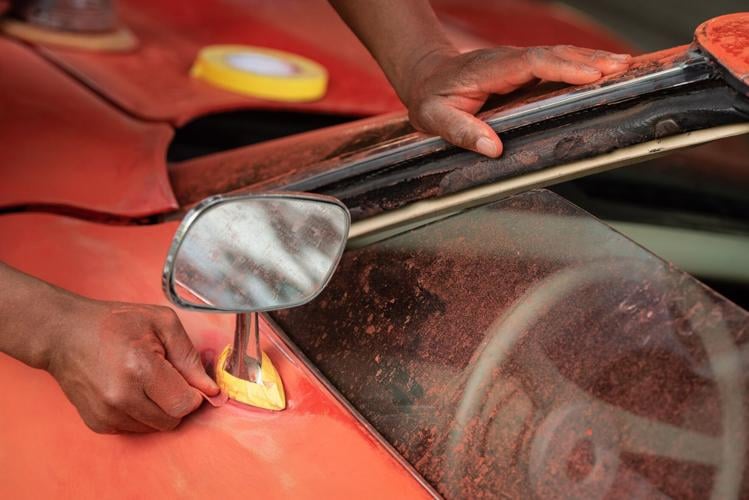
Henry White sands old paint on a 1977 Corvette to start his first total paint job on a car in over 26 years.
His case was unique. Under today’s legal standard, his first-degree murder conviction would have already been overturned because a state appellate court found that a Forsyth County prosecutor illegally used race to get rid of two potential Black female jurors, admitting it when challenged. But his case was upheld because back in the late 1990s, it wasn’t enough.
According to a motion filed by prosecutors and his attorney, another issue won his freedom — his trial attorney, Robert Leonard, was so ineffective at his job that White’s constitutional rights were violated. Because of the mistakes Leonard made at trial, White was denied a fair shot at fighting the first-degree murder charge he was facing.

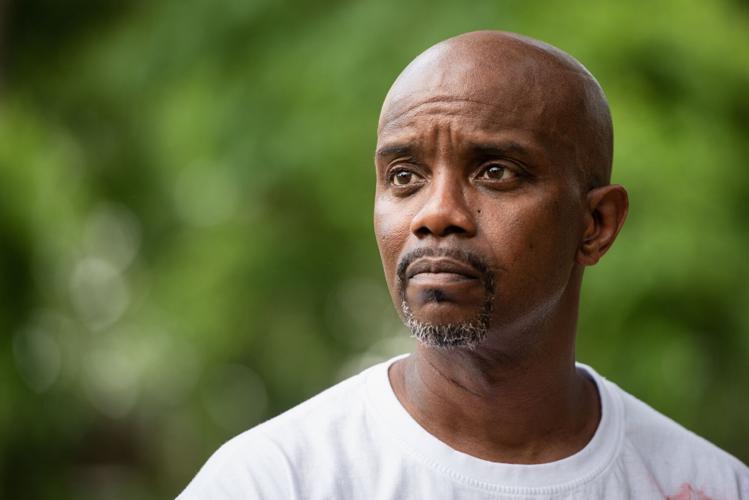
Henry White at his brother’s house in Kernersville. White was convicted in the murder of Carl Marshburg in 1997, but he claimed racism played a role in jury selection. He was released about a week ago after prosecutors and his attorney agreed that his trial attorney was ineffective. He pleaded guilty to second-degree murder and got time served.
Now, White’s main concerns are figuring out the world — he has streets to learn and smartphones to decipher. At 54, he has children, grandchildren and two great-grandchildren (who are on the way) to connect with.
“I always asked God not to let me die in prison and here I am,” he said.
A long journey
White grew up in Baltimore, Maryland and South Carolina. At one point, his mother moved to Baltimore, Maryland, where his uncle, Robert, his mother’s oldest brother, had an auto shop.
White said he would spend days in his uncle’s shop, learning about cars and cleaning up the floors.
He was enamored with exterior work (he didn’t like to do engine work) and he worked on cars from the time he was 12 until he was locked up at age 28.

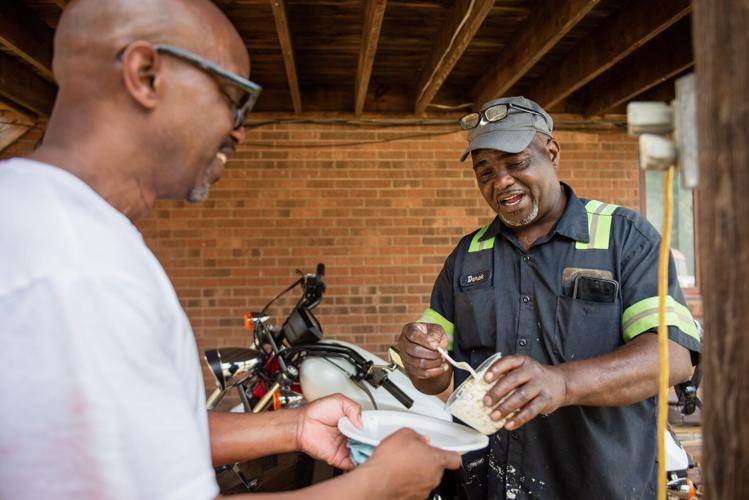
Derek White (right) forks out a serving of macaroni salad for his brother, Henry White, on Thursday, May 19 at his brother’s house in Kernersville
White said he worked for Earl Scheib Paint and Body Shop and helped oversee operations in several states, including Virginia, South Carolina and North Carolina.
On Feb. 16, 1996, Henry White and his cousin, Harry Beaufort, went to the paint shop in Winston-Salem so that Beaufort could pick up his last paycheck. Beaufort told Winston-Salem police and later testified at White’s trial that White went into the shop and he heard two gunshots. Beaufort testified that White later said he had shot Marshburn and stolen money from him.
White told police that he gave Beaufort a 9mm gun for safekeeping and that he dropped Beaufort off at a gas station before going to the paint shop to pick up the check. He said when he left the shop, Marshburn was still alive. Later, at a nearby parking lot, Beaufort got into the car and told White that he had shot Marshburn and robbed him.
To this day, White said he had nothing to do with Marshburn’s murder and that Beaufort was the one who committed the crime. Beaufort was never charged.
Marshburn’s body was found at about 9 a.m. on Feb. 17, 1996. Money was missing from the pocket of his shirt, where witnesses told police that Marshburn was known to keep money.
Forsyth County prosecutors pursued the death penalty against White but a Forsyth County jury recommended life in prison without the possibility of parole.
White appealed his case to the N.C. Court of Appeals on a number of issues, including racial discrimination in jury selection.

Henry White sands old paint on a 1977 Corvette to start his first total paint job on a car in over 26 years.
A U.S. Supreme Court decision called “Batson V. Kentucky” had already made it illegal to use race in jury selection. Prosecutors and criminal defense attorneys can use what are called peremptory challenge to get rid of potential jurors without giving a reason. But under the U.S. Supreme Court decision, a judge can hold a hearing if either side alleges that race was used in jury selection. Prosecutors who are challenged based on the Batson decision can give a non-racial reason for why they dismissed a potential Black juror.
In White’s case, Assistant District Attorney David Spence was challenged by White’s attorneys. He gave this reason about why he dismissed Sonya Jeter and Caryl Reynolds, both Black women, according to a 1998 opinion by the N.C. Court of Appeals:
“Both black females, both 27 years old, old enough. Almost the same age as the defendant. Sonya was personally opposed to the death penalty. Carolyn (sic) Reynolds is living with her mother, doesn’t have a stake in the community. She’s single, has an illegitimate child, health care provider. State thinks that people who want to save lives don’t want to take lives. And she doesn’t think having her purse stolen was a serious crime...And judge, on Miss Jeter, her cousin was convicted by Detective Rowe. Again, she’s another health care provider.”
This is not the first time Spence or the Forsyth County District Attorney’s Office has been accused of racial discrimination in jury selection. Spence, who is a prosecutor in Carteret, Craven and Pamlico counties, has repeatedly declined to comment.
Hambourger represents two other Forsyth County men — Thomas Larry and Russell William Tucker — who are both on death row for murder. Hambourger has filed an appeal for Tucker with the N.C. Supreme Court. Larry has an appeal pending in Forsyth Superior Court.
All three cases not only involve Spence but also involve the alleged use of a training document called “Batson Justifications: Articulating Juror Negatives.”
Hambourger has alleged in court papers that Forsyth County prosecutors used the training document in Tucker’s case and other cases to provide pre-packaged race-neutral reasons for why they got rid of potential Black jurors. She and other attorneys have additionally argued that those non-racial reasons are steeped in racial stereotypes about Black people.
Also cited in Tucker’s case is a study done by two Michigan State University law professors who say there is a pattern of racial discrimination in four Forsyth County cases. Spence was involved in all of those cases. In the four cases combined, Spence struck 63 percent of Black jurors but only 20 percent of non-Black jurors, according to court papers.
In White’s case, the N.C. Court of Appeals, noting the first three words out of Spence’s mouth, found in 1998 that race played a significant role in jury selection in White’s case. Until recently, White’s case was the only one in North Carolina history where a state appellate court made a finding that race played a role in jury selection.
But because Spence also gave several non-racial reasons, the court’s finding about race wasn’t enough to overturn White’s conviction. That was because at the time, race had to be the sole factor to get an conviction overturned and get a new trial. The legal standard has since changed.
If the court had ruled the same way in 2022, White’s conviction would have been overturned.
A shift
Elizabeth Hambourger, one of White’s attorneys, said she and attorney David Weiss looked at White’s case and asked White if they could represent him. White agreed.
They filed a motion for appropriate relief, a kind of appeal, in Forsyth Superior Court, asking a judge to overturn White’s murder conviction based on racial discrimination in jury selection. Judge Todd Burke of Forsyth Superior Court denied the request, saying that White was procedurally barred from raising the jury issue because he had previously raised it in another appeal.
Hambourger had thought that the Forsyth County District Attorney’s Office would agree that White’s case represented an injustice in need of correction. But prosecutors opposed the appeal.
But when the case reached the N.C. Court of Appeals, a shift happened.
“To my surprise, the Attorney General’s office agreed that this was an injustice,” Hambourger said.
Specifically, Zachary Dunn, an assistant attorney general, wrote that White’s claims should be heard and asked that the case be sent back to Forsyth Superior Court for an evidentiary hearing.
“Although the trial court correctly found that the procedural bars ... applied, the State concludes that under the unique factual and procedural circumstances presented, application of the bar in this specific case would result in a fundamental miscarriage of justice,” Dunn wrote in court papers.
Dunn told the court of appeals that this was not an easy decision.
“The State has considered its position carefully, and does not lightly request remand for a new hearing of an otherwise procedurally barred MAR claim,” Dunn said. “However, significant uncertainty exists around whether the trial court applied the correct standard in ruling on Petitioner’s Batson claim.”
The N.C. Court of Appeals, however, chose to take up the appeal and both Hambourger and the state Attorney General’s Office were in the process of preparing for oral arguments when the Forsyth County District Attorney’s found other issues that paved the way for overturning White’s conviction.
According to a joint motion for appropriate relief, Leonard did two things to violate White’s constitutional rights. One, he failed to pursue a motion to suppress statements White made to Winston-Salem police. Leonard would have been successful in that motion, the motion argues, because at the time White made the statements, Leonard represented White but was not there during the interrogation. That made the statements unconstitutional and inadmissible for trial. But Leonard withdrew the motion to suppress before there could be an evidentiary hearing.
Second, Leonard said in closing statements that White was guilty of armed robbery, an underlying felony for the first-degree murder charge. Those statements indicated to the jury that if White was guilty of the robbery, then he was guilty of the murder. Leonard, the motion argues, made those statements without consulting with White.
In recent correspondence with the Winston-Salem Journal, Leonard, who has been disbarred and was later convicted of embezzlement, has denied the allegations that he was ineffective in his legal representation of White.
As part of a plea deal, White agreed to plead guilty to second-degree murder. His first-degree murder conviction was thrown out and he was given a time-served sentence. That means he was released from custody on May 9.
During the hearing, his mother, Louise McCray, kept thanking God.
“I feel release from my heart,” she said. “I feel good. “I have my kids all together ... I feel so good.”
Family matters
When White went into prison, his daughter was only 7-months-old.
She’s now 26 and is a mother. She is pregnant with her second child.
White has three children and six grandchildren, including the one his daughter is carrying. He is about to become a great-grandfather. His oldest granddaughter is pregnant with twins, he said.
He is one of four brothers and has five sisters. One of his sisters, however, died as a young child.
When asked why he pleaded guilty to something he said he didn’t do, he said he did it for his mother.
His mother has had two heart attacks, one as recent as a couple of months ago.
“I didn’t want to be locked up in prison with my Mom dying on me,” he said.
He told Hambourger that whatever he had to do to get out of prison, he was willing to do it. But, he said, it hurt to plead guilty to second-degree murder.
At the May 9 hearing, Kathryn Baldwin, a daughter of Carl Earl Marshburn, called White by his first name and told him that she wished him nothing but the best. The two families hugged each other after the hearing.
His older brother, Derek White, said he always had faith that White would get out of prison.
“It’s not our time, it’s God time,” he said.
Derek White said he’s just happy to have White home.
He said his brother was always interested in jobs. That’s why when White came to his house on a Thursday, he put him to work.
“He come out and he wanted to work and I said, ‘Go to work,’” Derek White said, laughing. “I got plenty of work for him.”
Hambourger said she was struck by White’s integrity.
“He seems like someone who has tried really hard to make the most out of a hard situation,” she said.
Now that he’s out, White has plans. He wants to open up an auto shop in Greensboro. He and his brothers have scouted out a spot for the shop.
“I always kept faith,” he said.
PHOTOS & VIDEO: Henry Jerome White

Henry White stands for a portrait in front of a 1977 Corvette he’s repainting on Thursday, May 19, 2022, at his brother’s house in Kernersville, N.C. White was convicted in the murder of Carl Marshburg in 1997, but he claimed racism played a role in jury selection. He was released about a week ago after prosecutors and his attorney agreed that his trial attorney was ineffective. He pleaded guilty to second-degree murder and got time served.

Henry White stands for a portrait on Thursday, May 19, 2022, at his brother’s house in Kernersville, N.C. White was convicted in the murder of Carl Marshburg in 1997, but he claimed racism played a role in jury selection. He was released about a week ago after prosecutors and his attorney agreed that his trial attorney was ineffective. He pleaded guilty to second-degree murder and got time served.

Henry White sands old paint on a 1977 Corvette to start his first total paint job on a car in over 26 years on Thursday, May 19, 2022, at his brother’s house in Kernersville, N.C. White was convicted in the murder of Carl Marshburg in 1997, but he claimed racism played a role in jury selection. He was released about a week ago after prosecutors and his attorney agreed that his trial attorney was ineffective. He pleaded guilty to second-degree murder and got time served.

Henry White sands old paint on a 1977 Corvette to start his first total paint job on a car in over 26 years on Thursday, May 19, 2022, at his brother’s house in Kernersville, N.C. White was convicted in the murder of Carl Marshburg in 1997, but he claimed racism played a role in jury selection. He was released about a week ago after prosecutors and his attorney agreed that his trial attorney was ineffective. He pleaded guilty to second-degree murder and got time served.

Derek White (right) forks out a serving of macaroni salad for his brother, Henry White, on Thursday, May 19, 2022, at his brother’s house in Kernersville, N.C. Henry was convicted in the murder of Carl Marshburg in 1997, but he claimed racism played a role in jury selection. He was released about a week ago after prosecutors and his attorney agreed that his trial attorney was ineffective. He pleaded guilty to second-degree murder and got time served.

Henry White stands for a portrait in front of a 1977 Corvette he’s repainting on Thursday, May 19, 2022, at his brother’s house in Kernersville, N.C. White was convicted in the murder of Carl Marshburg in 1997, but he claimed racism played a role in jury selection. He was released about a week ago after prosecutors and his attorney agreed that his trial attorney was ineffective. He pleaded guilty to second-degree murder and got time served.

Henry White sands old paint on a 1977 Corvette to start his first total paint job on a car in over 26 years on Thursday, May 19, 2022, at his brother’s house in Kernersville, N.C. White was convicted in the murder of Carl Marshburg in 1997, but he claimed racism played a role in jury selection. He was released about a week ago after prosecutors and his attorney agreed that his trial attorney was ineffective. He pleaded guilty to second-degree murder and got time served.

Henry White stands for a portrait on Thursday, May 19, 2022, at his brother’s house in Kernersville, N.C. White was convicted in the murder of Carl Marshburg in 1997, but he claimed racism played a role in jury selection. He was released about a week ago after prosecutors and his attorney agreed that his trial attorney was ineffective. He pleaded guilty to second-degree murder and got time served.

Henry White sands old paint on a 1977 Corvette to start his first total paint job on a car in over 26 years on Thursday, May 19, 2022, at his brother’s house in Kernersville, N.C. White was convicted in the murder of Carl Marshburg in 1997, but he claimed racism played a role in jury selection. He was released about a week ago after prosecutors and his attorney agreed that his trial attorney was ineffective. He pleaded guilty to second-degree murder and got time served.

Henry White sands old paint on a 1977 Corvette to start his first total paint job on a car in over 26 years on Thursday, May 19, 2022, at his brother’s house in Kernersville, N.C. White was convicted in the murder of Carl Marshburg in 1997, but he claimed racism played a role in jury selection. He was released about a week ago after prosecutors and his attorney agreed that his trial attorney was ineffective. He pleaded guilty to second-degree murder and got time served.

Henry White sands old paint on a 1977 Corvette to start his first total paint job on a car in over 26 years on Thursday, May 19, 2022, at his brother’s house in Kernersville, N.C. White was convicted in the murder of Carl Marshburg in 1997, but he claimed racism played a role in jury selection. He was released about a week ago after prosecutors and his attorney agreed that his trial attorney was ineffective. He pleaded guilty to second-degree murder and got time served.

Henry White shares a meal of sausage, macaroni salad and ham salad with his brother, David White, during a break of working on cars on Thursday, May 19, 2022, at David’s house in Kernersville, N.C. Henry was convicted in the murder of Carl Marshburg in 1997, but he claimed racism played a role in jury selection. He was released about a week ago after prosecutors and his attorney agreed that his trial attorney was ineffective. He pleaded guilty to second-degree murder and got time served.

Henry White sands old paint on a 1977 Corvette to start his first total paint job on a car in over 26 years on Thursday, May 19, 2022, at his brother’s house in Kernersville, N.C. White was convicted in the murder of Carl Marshburg in 1997, but he claimed racism played a role in jury selection. He was released about a week ago after prosecutors and his attorney agreed that his trial attorney was ineffective. He pleaded guilty to second-degree murder and got time served.

Henry White on Thursday, May 19, 2022, at his brother’s house in Kernersville, N.C. White was convicted in the murder of Carl Marshburg in 1997, but he claimed racism played a role in jury selection. He was released about a week ago after prosecutors and his attorney agreed that his trial attorney was ineffective. He pleaded guilty to second-degree murder and got time served.