

Henry Jerome White has spent the past 25 years in prison, but on Monday, he saw his first-degree murder conviction overturned because his trial attorney represented him so poorly that his constitutional rights were violated.
Under a plea deal, White, 54, pleaded guilty to second-degree murder in the 1996 death of Carl Edward Marshburn. Judge David Hall of Forsyth Superior Court sentenced White, who had been serving a life in prison without the possibility of parole, to between about 13 years and 16 years in prison and ordered him immediately released with time served. White was released about 5 p.m. Monday.
Louise McCray, White’s mother, sat in one of the rows of seats in the middle of Courtroom 5A, surrounded by some of her other children and family members. She could hardly contain her joy when she heard that her son was getting out of prison. She called it one of the best Mother’s Day presents she could have received.
People are also reading…

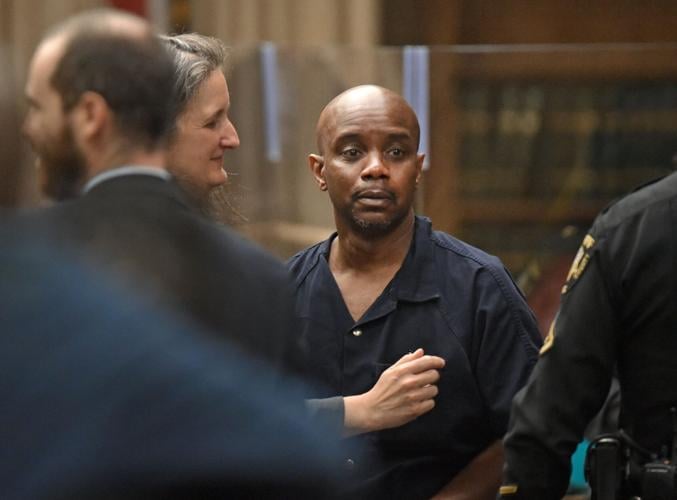
Henry White looks at his family after his first-degree murder conviction was vacated on Monday.
“Thank you,” she kept saying over and over again.
“I feel release from my heart,” McCray said after the hearing. “I feel good. I have my kids all together … I feel so good.”
Unique case
White’s case is unique in North Carolina history. Until recently, White’s was the only case where a state appellate court had recognized that racial discrimination played a role in jury selection. But in 1998, under the legal standards at play at the time, a showing that race played a significant role in White’s case wasn’t enough to overturn it. Race had to be the sole factor in jury selection in his case.
David Spence, a Forsyth County prosecutor, was shown to have explicitly used race in dismissing two Black female jurors. Under the U.S. Supreme Court decision, Batson V. Kentucky, race is not supposed to play any role in jury selection. If there is a challenge, a judge is supposed to hold a hearing during which prosecutors and criminal defense attorneys are allowed to give a race-neutral reason for why they dismissed a juror.

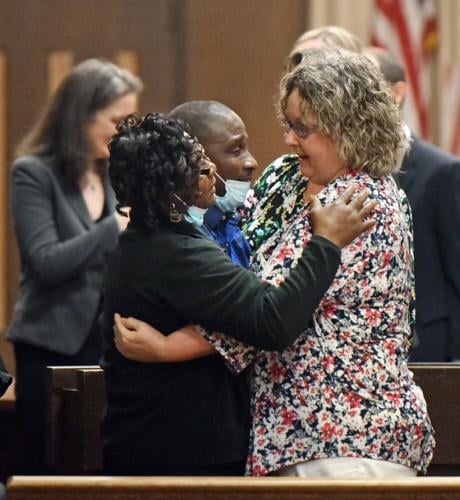
White’s mother, Louise McCray (left), hugs Kathryn Baldwin, daughter of Carl Marshburn, after the hearing.
In White’s case, Spence, when challenged, began by saying that the jurors were two “Black females” before he gave several nonracial reasons. Under today’s legal standard, the N.C. Court of Appeals finding that race played a significant role in jury selection in White’s case would be enough to overturn White’s conviction and order a new trial.
White had an appeal pending in N.C. Court of Appeals asking the appellate court to do just that. Last year, Zachary K. Dunn, an assistant N.C. attorney general, asked the court of appeals to send the case to Forsyth Superior Court for an evidentiary hearing on the jury discrimination issue.
Hambourger is an attorney in two other cases in which the Forsyth County District Attorney’s Office is accused of racial discrimination in jury selections. All three cases involve Spence, and they all allege that prosecutors used a training document called “Batson Justifications: Articulating Juror Negatives.”

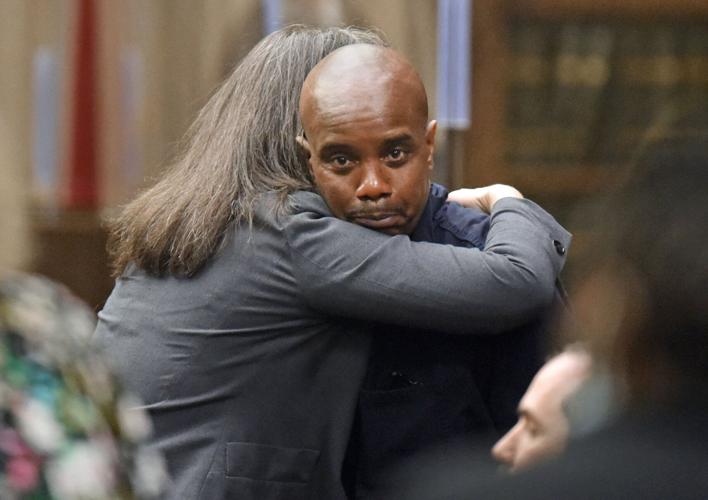
Henry Jerome White gets a hug from his attorney, Elizabeth Hambourger, after his first-degree murder conviction was overturned during hearing Monday at the Forsyth County Hall of Justice. White was convicted of killing Carl Marshburn in 1996.
Hambourger and other attorneys representing the men argue that Forsyth County prosecutors used the training document to provide ready-made race-neutral reasons for why they got rid of potential Black jurors. One of the cases — Russell William Tucker — is pending in N.C Supreme Court.
Another — Thomas Michael Larry — is pending in Forsyth Superior Court.
Attorney issues
But on Monday, Forsyth County prosecutors Jane Garrity and Penn Broyhill and White’s attorney, Elizabeth Hambourger, filed a joint motion for appropriate relief based on an entirely different issue — ineffective assistance of counsel.
According to the motion, White’s trial attorney, Robert Leonard, did two things that violated White’s constitutional rights.
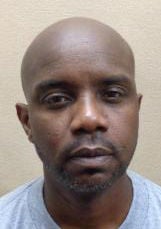
White
First, according to the motion, Leonard made statements in closing arguments at White’s trial in which Leonard told a jury that White committed the armed robbery. Prosecutors were using the felony murder rule to convict White, meaning that they alleged that White killed Marshburn while also committing another felony, armed robbery. White had no previous criminal record when he went to trial.
Leonard said this during closing arguments, according to the motion: “Now, everybody got a breaking point, and I think Henry found out where his was. Can’t say Henry wasn’t involved early on.”
Those statements indicated to the jury, the motion said, that if White was guilty of the robbery, then he was also guilty of murder.
“There is no indication on the record that White consented to his attorney making such an admission,” the motion said. “The parties agree that this was ineffective assistance of counsel and structural erro. Prejudice is presumed, and White is entitled to a new trial.”
That’s not all Leonard is accused of doing wrong at White’s trial. Leonard represented White when Winston-Salem police interrogated White about Marshburn’s murder. But Leonard wasn’t there.
Since Leonard wasn’t at the interrogation, White’s statements should not have been used at trial because they were unconstitutional, the motion said. Leonard filed and then withdrew a motion to suppress the statements and he failed to object to testimony that brought in White’s statements at trial, the motion said. If Leonard had pursued the motion to suppress, White’s statements would have been thrown out and a jury likely would never have convicted White of first-degree murder, the prosecutors and Hambourger said in the motion.
Leonard, 77, was disbarred in 2005 on allegations that he mishandled a client’s money. He served about six years in prison after he was convicted in 2016 for embezzling at least $300,000 from a sick man.
Leonard could not be reached Monday for comment.
Feb. 16, 1996
Broyhill said Carl Marshburn was a manager of Earl Scheib Paint and Body Shop in Winston-Salem. On Feb. 16, 1996, Henry White and his cousin, Harry Beaufort, went to the paint and body shop so Beaufort could pick up his last paycheck. Beaufort told Winston-Salem police that White went into the shop and then he heard two gunshots. Beaufort told police that White said he had shot Marshburn and stolen money from him.
White told police that he gave Beaufort a 9mm gun for safekeeping and that he dropped Beaufort off at a gas station before going to the paint shop to pick up the check. When he left, Marshburn was still alive, White told police. Later, at a nearby parking lot, Beaufort got into the car and told White that he had shot Marshburn and robbed him.
Marshburn’s body was found at about 9 a.m. on Feb. 17, 1996. Money was missing from the pocket of his shirt, where witnesses told police that Marshburn was known to keep money.
Forsyth County prosecutors pursued the death penalty against White but a Forsyth County jury recommended life in prison without the possibility of parole.
On Monday, Marshburn’s two daughters, Kathryn Baldwin and Elizabeth Marshburn, sat on the front row of Courtroom 5A. Two of Marshburn’s grandchildren, Daniel Marshburn Baldwin and LeighAnne Baldwin, also were there.
Kathryn Baldwin called White by his first name and told him that she wished him nothing but the best upon his release.
White didn’t say anything in court but he passed a letter along addressed to Marshburn’s family.
After the hearing ended, the two families embraced each other.
PHOTOS: Henry Jerome White sentence vacated; pleads guilt to lesser charge
Henry Jerome White sentence vacated
Henry White looks at his family after his first-degree murder conviction was vacated on Monday.
Henry Jerome White sentence vacated
Henry Jerome White gets a hug from his attorney, Elizabeth Hambourger, after his first-degree murder conviction was overturned during hearing Monday at the Forsyth County Hall of Justice. White was convicted of killing Carl Marshburn in 1996.
Henry Jerome White sentence vacated
White’s mother, Louise McCray (left), hugs Kathryn Baldwin, daughter of Carl Marshburn, after the hearing.
Henry Jerome White sentence vacated

Judge David Hall speaks with Assistant District Attorney Penn Broyhill during a hearing for Henry Jerome White, Monday, May 9, 2022 in the Forsyth County Hall of Justice. White was convicted of first-degree murder in the 1996 death of Carl Marshburn. His first-degree murder conviction was vacated Monday after a Forsyth County judge determined that his trial attorney was so ineffective that the man's constitutional rights were violated.
Henry Jerome White sentence vacated

Louise McCray (left), mother of Henry Jerome White, Kathryn Baldwin, daughter of Carl Marshburn, hug after a hearing, Monday, May 9, 2022 in the Forsyth County Hall of Justice. White was convicted of first-degree murder in the 1996 death of Carl Marshburn. His first-degree murder conviction was vacated Monday after a Forsyth County judge determined that his trial attorney was so ineffective that the man's constitutional rights were violated.
Henry Jerome White sentence vacated

Elizabeth Hambourger, attorney for Henry Jerome White, talks with his family before a hearing, Monday, May 9, 2022 in the Forsyth County Hall of Justice. White was convicted of first-degree murder in the 1996 death of Carl Marshburn. His first-degree murder conviction was vacated Monday after a Forsyth County judge determined that his trial attorney was so ineffective that the man's constitutional rights were violated.
Henry Jerome White sentence vacated

Assistant District Attorney Jane Garrity speaks with the family of Carl Marshburn during a hearing for Henry Jerome White, Monday, May 9, 2022 in the Forsyth County Hall of Justice. White was convicted of first-degree murder in the 1996 death of Carl Marshburn. His first-degree murder conviction was vacated Monday after a Forsyth County judge determined that his trial attorney was so ineffective that the man's constitutional rights were violated.
Judge David Hall retires from Forsyth County bench

Judge David Hall
Henry Jerome White sentence vacated

Henry Jerome White enters the courtroom for a hearing, Monday, May 9, 2022 in the Forsyth County Hall of Justice. White was convicted of first-degree murder in the 1996 death of Carl Marshburn. His first-degree murder conviction was vacated Monday after a Forsyth County judge determined that his trial attorney was so ineffective that the man's constitutional rights were violated.
Henry Jerome White sentence vacated

Assistant District Attorney Penn Broyhill during a hearing for Henry Jerome White, Monday, May 9, 2022 in the Forsyth County Hall of Justice. White was convicted of first-degree murder in the 1996 death of Carl Marshburn. His first-degree murder conviction was vacated Monday after a Forsyth County judge determined that his trial attorney was so ineffective that the man's constitutional rights were violated.